
 |
"Benefits of being part of the EMCS global community"
|
|---|---|
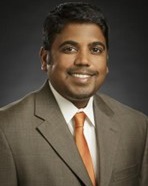
| Dr. Vignesh Rajamani Immediate Past President of the IEEE EMC Society |
Abstract:
As the world's largest organization dedicated to the development and distribution of information, tools and techniques for reducing electromagnetic interference, IEEE Electromagnetic Compatibility Society is the leading authority when it comes to electromagnetic compatibility research, design, test and applications. With a strong membership around the world, the premium symposium offerings, EMC+SIPI conference in the US, APEMC in Asia and EMC Europe in Europe serves as a bridge and provide a broad exchange platform for both academia and industry. In this talk, details about the EMCS educational offerings to its membership and strategic partnerships that we have with IEEE and non-IEEE organizations will be discussed. The EMC Resource center which is available for free for any EMCS member is the place where anyone that is new to the field of EMC or anyone who would like to brush up their fundamentals or anyone that is wanting to learn about an emerging EMC issue can go to and find lectures and training materials that will benefit them will also be highlighted. EMCS is poised to offer resources to acquire new skills, advance your professional development, and provide numerous opportunities for involvement, recognition, and reward. Come and be part of the Team!
Biography:
Dr. Vignesh Rajamani is an expert in the electromagnetic characterization and application of reverberation chambers with
Rohde and Schwarz, an industry-leading technology company that works on shaping the future of communications, information and security.
He is primarily responsible for driving business growth and building relationships with various industries.
A main thrust of his research and project experience in the area of reverberation chambers has been towards increasing test accuracy.
In his previous role as a Manager at Exponent, he assisted clients with identifying the root cause of the failures of electronic
systems and providing guidance on possible solutions, in the area of EMI/C. Prior to joining Exponent,
Vignesh was with Oklahoma State University as a Visiting Assistant Professor where he taught courses in engineering design and
performed research in probability of failure of electronic systems in harsh electromagnetic environments.
He is a subject matter expert for various standard bodies. Vignesh is the Immediate Past President of the IEEE EMC Society,
and the General Chair for the upcoming 2024 IEEE International Symposium on EMC+SIPI, August 5 - 9, 2024, in Phoenix, Arizona.
 |
"EMC/SI/PI into the Exciting Future of Computing, Communication, and AI"
|
|---|---|
| Dr. En-Xiao Liu Senior Principal Scientist & Deputy Department Director, Institute of High Performance Computing (IHPC), Agency for Science, Technology and Research (A*STAR), Singapore Adjunct Associate Professor, National University of Singapore |
Abstract:
Electromagnetic Compatibility (EMC) with the later pronounced Signal Integrity (SI) and Power Integrity (PI) is both old and young, both maturing and emerging over time. The mission of EMC in harmonizing within and across electrical and electronic systems has not yet been accomplished, but constantly evolving in the current and future exciting era of persistent digitization, pervasive connectivity, and procreative intelligence.
At the heart of the hardware in computing, communication, and artificial intelligence (AI) are the microelectronics and microwave electronics. Sixty years on, Moore's law is still alive, but no longer full steam ahead, while approaching the ultimate physical limit. Heterogenous integration and integration of Chiplets are marching energetically on the alternative "more-than-Moore" path. Digital chips are prevailing, analog chips are here staying, while Optical/photonic chips, Neuromorphic chips, Quantum chips are emerging or blinking in the faraway horizon. The "one generation per decade" rule is fuelling the development of future 6G communication. Transformer-propelled AI created a sensation, but the artificial general intelligence may not emerge too soon, while one sure thing is that AI is hardware hungry and power hungry.
EMC/SI/PI is no stranger to computing, communication, and AI hardware, both in terms of ensuring their harmonious and safe operation as well as mitigating their electromagnetic noise. Grounding, filtering, and shielding are the three common recipes for EMC, which are all old tricks but with new lives.
In this talk, I will first connect some past dots of EMC including those that I have witnessed and researched on, then elaborate on some other dots of EMC that are currently happening in relation to computing, communication and AI hardware. Additionally, I will attempt to connect some future dots through extrapolation and imagination.
[Acknowledgment] the work included in this talk is partially funded by the Singapore RIE2025 MTC Programmatic Fund with the Grant No.: M23M3b0064.
Biography:
En-Xiao Liu received his PhD degree from the National University of Singapore (NUS) in 2005. In the same year he joined the Institute of High Performance Computing (IHPC), Agency for Science, Technology and Research (A*STAR), Singapore, where he is currently Senior Principal Scientist and Deputy Department Director of the Electronics and Photonics Department. He is also an adjunct Associate Professor at NUS. He has published more than 130 papers and three book chapters. His research interests are in the areas of computational electromagnetics, high-speed electronics, and electromagnetic compatibility (EMC).
Dr. Liu received Singapore President's Technology Award (2019), the ASEAN Outstanding Engineering Achievement Award and IES Prestigious Engineering Achievement Award (2019), the IEEE EMC Society Technical Achievement Award (2016), Best Paper and Best Industry Project Awards. He was an IEEE EMC Society Distinguished Lecturer. Presently he is Associate Editor of four IEEE journals (T-EMC, T-SPI, L-EMCPA and T-CPMT). He has been serving the IEEE EMC Singapore Chapter as Chair and Executive Committee Member, and contributing regularly to various international conferences in different capacities, such as Technical Program Chair, International Advisory/Steering Committee member, and General Chair.
 |
"EMC Design and Evaluation Technology Supporting Autonomous Driving"
|
|---|---|
| Prof. Osami Wada Professor Emeritus, Kyoto University Visiting Professor, Center for Future Communications Research, Nagoya Institute of Technology |
Abstract:
In order to ensure vehicle safety, high reliability is required for in-vehicle electrical and electronic equipment. In particular, in order to realize autonomous driving, it is necessary to ensure the reliability of the in-vehicle communication networks which also should have large communication capacity. Recent electric vehicles have been equipped with many power electronic devices that can be a source of electromagnetic noise. Therefore, achieving high functionality, high efficiency, EMC, and reliability are important issues.
For reliability and system integrity of communication in the complex system of in-vehicle electrical and electronic equipment, international standardization of EMC test methods for in-vehicle equipment and for integrated circuits and electronic components have been carried out in ISO, IEC, and CISPR. There is a strong demand to develop equipment that achieves high functionality while complying with these international standards, and the design technology that realizes this will be the key to the future society. This presentation will provide an overview of these technologies and recent trends in international standardization.
Biography:
Osami Wada is a Professor Emeritus of Kyoto University. He received B.E., M.E. and Dr. Eng. Degrees in Electronics from Kyoto University. From 1988 to 2005 he was in the Faculty of Engineering, Okayama University, and from 2005 to 2023 he was a Full Professor in the Department of Electrical Engineering at Kyoto University, where he engaged in the study of EMC of electronic circuits and systems and EMC macro modeling of integrated circuits. After his retirement in March 2023, he joined the Center for Future Communications Research in Nagoya Institute of Technology as a visiting professor, where he is engaging in EMC evaluation of automotive Ethernet and electronic devices.
Prof. Wada was the Chair of IEEE EMC Society Japan Chapter from 2012 to 2013, and the Chair of the Technical Committee of EMC (EMCJ) in the Institute of Electronics, Information and Communication Engineers of Japan (IEICE) from 2017 to 2018. He is a Fellow of IEICE, a member of IEEE and the Japan Institute of Electronics Packaging (JIEP).